Dante Alighieri’s Inferno is a fine standalone. Hell is thick, dark, exhausting & simply escaping it offers satisfaction enough for the majority of readers. There are more reasons people often vacate The Comedy at Purgatorio. If one continues to climb Mount Purgatorio it is at Canto 51 & 52 (of 100) that we reach the turning point or prime catharsis for Dante’s real life. Catharsis (Greek) & Purgatorio (Latin) are close to the same words.
The dilemma of the entire poem is love. Dante had a secret, burning, never realized, thus unrequited love for Beatrice. Also take into account his later exile from the city of Florence. On top of that, consider that Dante poetically tells us in the first three lines of the book that he was in the midst of most likely a PTSD episode or emotional time travel event (love madness or obsessive love can manifest due to PTSD). All the former emotions from Dante’s Vita Nuova time period may have flooded back in coupled with the emotions from his recent exile.
I must point out that Dante’s Limbo is the first circle of the Inferno because that is the initiation for a similar experience to Dante’s. The modern usuage of “Limbo” is not knowing something or waiting for an answer–incorrect according to Dante’s usage. His Limbo is a constant desire coupled with the tormenting knowledge that there is no hope of fulfillment:
“For such defects, and not for other guilt,
Lost are we and are only so far punished,
That without hope we live on in desire.”
Inferno 4.40-42
Dante may have been experiencing a PTSD duality when he began writing The Divine Comedy as they call it, but the proper title per Dante “Here beginnith the comedy of Dante Alighieri, a Florentine by birth, but not in manners”:
“MIDWAY upon the journey of our life”
Inferno 1.1
It is our (plural) life (singular). It is not our lives because Dante is not including our lives in the equation, but the separate parts of his life, to wit–him from sometime from the past occupying the same space as him from the present.This time-travel duality was best reflected by Dante in Inferno 8 & 9. The cantos reflect emotional events from two distant times in Dante’s life. Both events are portrayed just outside the walls of the city of Dis.
The walls of Dis separate the Inferno’s 5th & 6th Circles. The 5th Circle is the punishment for the Irascible & the Sullen or those overcome by bitterness–wrath. Both real life events (Beatrice & Exile) threatened to leave Dante in a stasis–bitterness. In the poem both events attempt to permanently halt his journey in the circle of wrath.
Inferno 8 reflects the emotions from Dante’s exile. The city of Dis is a hellish representation of the city of Florence (IE it has mosque towers instead of Christian spires). When Dante & his guide Virgil reach the walls of the city, the denizens on top of the wall state that Virgil can come in, but Dante cannot pass. Virgil is the symbol for Dante’s poetry. Florence wanted the poetry (or an association with it), but not the poet. Dante could have been in a perpetual state of bitterness over his exile.
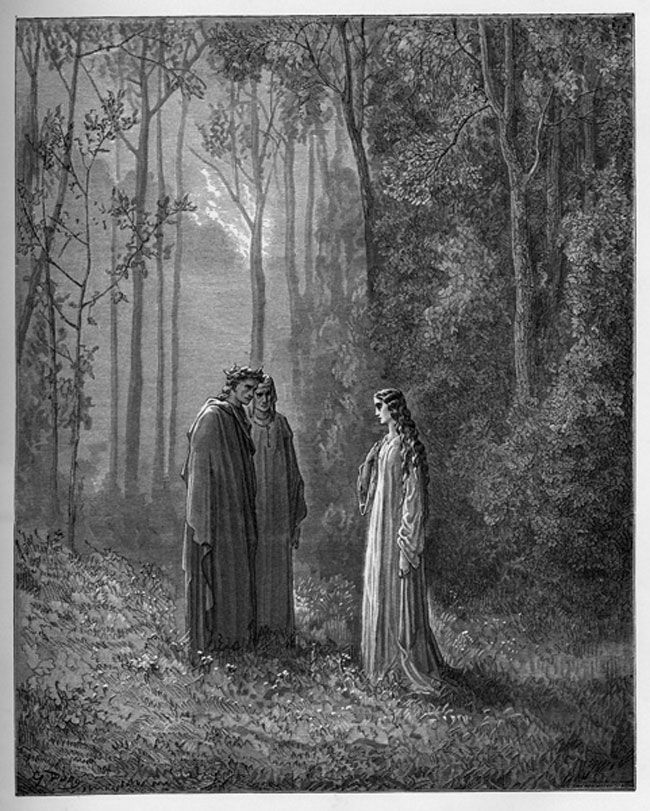
Inferno 9–we are still outside the walls of Dis. This canto reflects the emotions from Dante’s episode in Vita Nuova XIV. In the Inferno, three Furies land on the mosque towers & call for Medusa to turn Dante into stone–a transfiguration. In Vita Nuova XIV, Dante was neck deep in his love madness for Beatrice. His friend invited him to what was allegedly a simple gathering of lovely women–he did not even know Beatrice would be there.
The entry & sonnet are slightly ambiguous, but the historian Boccaccio believes it was a small wedding reception dinner. The new bride–Beatrice. At the sight of Beatrice & her love interest, as Dante puts it, he suffered a transfiguration. He became pale & sickly. A few of the women at the gathering (The Furies) & Beatrice (Medusa) began to giggle & mock Dante for his sickly appearance. Dante was mocked by the woman he loved during a great moment of suffering. Again, Dante could have been perpetually bitter over the matter.
“You join with other ladies to deride me
and do not think, my lady, for what cause
I cut so awkward and grotesque a figure…”
Vita Nuova XIV, 1-3
Dante & Beatrice’s reciprocal relationship prior to his transfiguration, according to Dante, was nothing more than Beatrice giving Dante one friendly greeting on the street (love madness). It was a long, secret, building, burning love I had for a woman that initiated my event. Like Dante with Beatrice, I fell in love with her at first sight, but it was a long time before any association. At best, it’s climax, the relationship was only an association between us in the setting of a formal environment.
It was so much more to me because the long building secret desire (Proverbs 27:5). Once the association went south, even though it never actually went north, I had heard 2nd hand that she claimed, “We were never even friends.” You can be frozen in a state bitterness over such a thing.
Once you are able to resume a fully functional state after a bout with love madness or unrequited love, you desire answers. It is apparent Dante long sought answers to the same questions I had.
When we feel the true emotion of love, we believe it is automatically good. But if it is good, how could it lead us into disaster? How can the recipient hate it so much? Was a person’s love madness a simple pride problem instead? Most importantly–was it actually love?
In Inferno, sin is punished. In Purgatorio, vice is purged. Both realms have circles of wrath. Dante spends much time & was halted before leaving the circles of wrath in Inferno & Purgatorio. It is Purgatorio’s circle of wrath where Virgil provides the discourse on love. This discourse provides Dante with some answers to questions I posted in the paragraph above:
“Hence thou mayst comprehend that love must be
The seed within yourselves of every virtue,
And every act that merits punishment.”
Purgatorio 17.103-105
“The natural was ever without error;
But err the other may by evil object,
Or by too much, or by too little vigour.”
Purgatorio 17.94-96
“Now may apparent be to thee how hidden
The truth is from those people, who aver
All love is in itself a laudable thing,
Because its matter may perchance appear
Aye to be good; but yet not each impression
Is good, albeit good may be the wax.”
Purgatorio 18.34-39
I love the allegory of the wax. The wax is love & good nonetheless–regardless of the impression (seal) in it.
Love in itself, is intrinsically good. Enter the object/subject of that love (John 3:19) or the degree in respects to a certain object/subject. During my event, which included the unrequited love, those I told said it was obsession. I was offended by the claim & countered that it was love. We were both right according to Dante. Love madness is love…but it’s not destiny. There is the rub–the thought that it must destiny due to the personal strength of the emotion.
In conclusion, if you suffer through obssession or love madness (I consider the latter a more accurate label), even if it is or isn’t a byproduct of something else–you want some answers. Is loving someone who doesn’t love you (or doesn’t return it to nearly the same degree) some sort of crime? No, because who can understand the subject of unrequitted love better than God?
John 1:11 “He came unto his own, and his own received him not.”

 THE EXILE OBSERVER