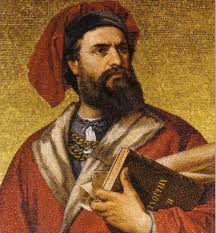
Like many movies, some of the greatest real life adventures weren’t entirely intended–with that I’ll introduce Messer Marco Polo.
I never attended any history class, school nor college, that did Marco Polo’s The Travels any true justice. The book isn’t fiction but it’s a more comparable to a Lord of the Rings novel than a standard history book:
“Along way beyond this kingdom, still farther to the north, is a province which is called the Land of Darkness, because perpetual darkness reigns there, ulit by sun or moon or star–The people here have no ruler; but they live like brute beasts in subjection to none.”1
“And I assure you that these dwellers in the Darkness are tall and well-formed in all their limbs, but very pale and colourless.”2
Above, Messer Marco spoke of some peoples he encountered in Russia, but his epic style transmission produced something close to encountering the lawless frost giants of the dark, glacial nether world. So non-fiction, but much more colourful.
To return to the opening, that his great adventure or travel to China wasn’t his original intent; Messer Marco and his brother set out from Venice to peddle some jewels in the east. He sailed from Constantinople to a Christian stronghold located on the shores of modern-day Ukraine.
He continued to travel east from there until they reached the court of Barka Khan (a lesser khan sujbect to the Great Khan, Kublai). Barka loved the jewels and Messer Marco stuck around for a year due to the profit, but then war broke out between Barka and another lesser khan of the Syrian Levant named Hulagu. Therefore, Messer Marco risked arrest by either warring faction if he returned by the way he came–so he traveled further east.
Messer Marco crossed the Tigris River, and a desert, until he reached a great city in Persia–in which he resided for 3 years because he couldn’t safely travel anywhere else. During that time Hulagu had defeated Barka in the afforementioned war and Hulagu sent some emissaries out from the Levant to travel to the Great Khan in China.
These emissaries encountered Messer Marco in Persia and were not only shocked to see a Latin so far east, but also told him that the Great Khan had never seen a Latin before and desired to meet one. The emissaries guaranteed him safe travel to China and a fortune as a result.
The Great Khan loved Messer Marco for a particular reason–Kublai’s empire was so huge that he probably never saw half the people & cultures that he ruled over. When Kublai would send ambassadors out for taxes or trading, the ambassadors would return with a strictly numbers report. The Great Khan would call them “dunces” due to the fact that their business reports displeased him. However, when he sent Messer Marco out as an ambassador, he would return with business numbers and a report concerning the peculiar customs & courtesies of the subjects Kublai had never seen. His cultural reports pleased the Great Khan.
As time went on the Great Khan’s and Messer Polo’s relationship was more akin to flat-out chums rather than political or business associates. Apparently Kublai Khan liked Messer Marco a little too much because the Great Khan detained him as an ambassador for 17 years (Marco & his brother had asked on several occasions to return home, but to no avail).
Finally, the lord of the Levant’s queen had died & this lord desired a new queen of the same lineage; therefore, he sent an envoy to the Great Khan for this new queen of the same lineage. When the envoy escorted the new queen back, many roads had been destroyed due to wars between lesser khan’s–so the envoy couldn’t find it’s way and had to return to the court of the Great Khan.
Due to being an ambassador, Messer Marco was familiar with India and it’s sea–so the Great Khan gave him leave (with letters to the Pope and many kings of Europe) to lead the marriage envoy back to the Levant by that route; after which–Messer Marco Polo returned home after 24 years abroad.
There are plethora of interesting stories in Marco Polo’s The Travels, an example: the Great Khan had a nemesis named King Kaidu, but the Great Khan never destroyed Kaidu because he was his nephew. King Kaidu had a daughter named Alyaruk, which meant ‘bright moon.’ Kaidu wanted his daughter to marry; however, he gave his daughter the privelege of marrying any man she chose. Alyraruk was a great warrior and knew what she wanted out of a husband.
The situation was simple, Alyraryk would only take a husband that could physically best her or pin her to the ground in a wrestling match. These wrestling matches became spectacles in the king’s court; a suitor would come in, wrestle Alyraryk to win her hand, and lose. When the suiter lost he had to give Alyraryk 100 horses. The end of the matter was that the king’s undefeated daughter owned over 10,000 horses.
Another short example from Messer Marco–it concerns a custom of the Tartars (Mongols):
“…when there are two men of whom one has had a male child who has died at the age of four, or what you will, and the other has had a female child who has also died, they arrange a marriage between them. They give the dead girl to the dead boy as a wife and draw up a deed of matrimony. Then they burn this deed, and declare that the smoke that rises into the air goes to their children in the other world…”3
They also held a wedding feast amongst other things for the newlywed-but- deceased children.
Messer Macro said no European Christian King nor Muslim Middle Eastern ruler came close to the power & dominion of the Great Khan–that fact is probably why little to even no information is routinely taught concerning The Travels in our Western history classes. Aside from a few Italian trading cities (where Messer Marco came from), Europe wasn’t doing good at all, so–let’s mostly skip that time period in our history classes and get to the Renaissance & the discovery of the New World.
I could quickly pop off many more examples from the book, but I will conclude: if one relies only on what history books or wikipedia or such have to say about Marco Polo’s The Travels–then such a one is truly missing out. I consider The Travels an essential source-material read for anyone who loves history.
(All citations are from Marco Polo’s The Travel’s, Penguin Classics)
 THE EXILE OBSERVER