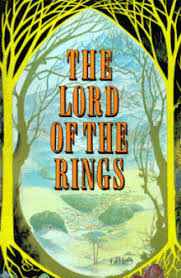
The following are my interpretations regarding a few routinely discussed subjects from The Lord of the Rings.
THE RING OF POWER
For decades those who appreciate JRR Tolkien’s literary works have debated if the ring of power is an allegory. It is not, the ring of power represents power, but the thought that there is a hidden meaning is still a correct line of thought. The hidden meaning of the general term power lays hidden in individuals or in this case the ringbearers.
What is power? Knowledge? Strength? Wealth? Authority? Attractiveness? Liberty? Alas, the subjectivity of power is what causes the debate. Thus, the ring of power grants different powers to different users save for the standard powers of invisibility & life extension. Why are those the two standard features for the ring of power?
–Life extension is one of the most common desires
–The power of invisibility probably offers one the greatest temptations to do evil
To elaborate on the last point–how would the average person utilize invisibility? Perhaps frightening other people, cheating, invading other’s privacy or a multitude of potential crimes–petty or grievous.
GOLLUM & THE RING
Back to the subjectivity of power–what was the power Smeagol/Gollum sought? Although I love every Peter Jackson rendition of the series, one could not glean the power Gollum lusted after on the big screen–the ring was simply precious to creature in the movie.
We learn from The Fellowship of the Ring novel (TFOTRN) that Smeagol not only lusted after a specific branch of knowledge (for power), but he was also Gollum before Gollum physically manifested due to the ring:
“He was interested in roots and beginnings; he dived into deep pools; he burrowed under trees and growing plants; he tunnelled into green mounds; and he ceased to look up at the hill-tops, or the leaves on trees, or the flowers opening in the air: his head and his eyes were downward.”
The quote concerns Smeagol before the ring of power. That lust did not cease after he murdered his cousin Deagol in order to acquire the ring. Yes, Gollum hated sunlight, but that was not his entire motive for his retreat into the caves of the Misty Mountains. Gollum believed that the roots of the mountains certainly held a multitude of secrets regarding roots & beginnings. Gandalf informs us of the end of Gollum’s endeavor in TFOTRN:
“All the ‘great secrets’ under the mountain had turned out to be just empty night: there was nothing more to find out, nothing worth doing, only nasty furtive eating and resentful remembering.”
There is more to Smeagol’s backstory in the novel, but two key points in conjunction with the ring of power: 1) Gollum essentially became invisible without the aid of the ring; he chose to live in isolation. 2) Instead of acquiring secret knowlege & becoming wise, Gollum became base, uncivilized and closer to a beast than his hobbit-kin.
The 2nd point highlights the malevolence of the ring of power in that it grants the opposite of the power a ringbearer seeks.
As the concept of power is different to different people & the ring grants power (attached to malevolence) according to stature; beings like Gandalf & Galadriel had to reject the ring for the sake of the world. Their great magnified powers would have only wreaked mass destruction in the end–regardless of their motives.
FRODO & THE RING
As mentioned, while Gollum did have other motives an obsession with the ring is a common side effect for all ringbearers. Whether people desire to do good or evil, many covet power in order to accomplish those ends. However, Bilbo & Frodo Baggins didn’t seek power–so why were they obsessed with owning the ring?
Answer: The greatest power that allowed them to resist the seductions of the ring was what was exploited in them by the ring–contentment. Hobbits love good tilled earth, gardening, drinking, smoking, comfort, but most of all peace & quiet. They don’t like adventure; they don’t like change. Their desires are simple; they are easily contented–which means (in the tongue of Mordor >) they can put up with much more crap than the average humanoid.
For the hobbits, getting rid of the ring of power would cause the disruption. Frodo’s contentment (conservativism) got the better of him–he became used to the ring. Getting rid of the ring meant change & Frodo couldn’t toss the ring into the cracks of Mount Doom in the end–he required an unintended assist from Gollum.
Frodo’s precious was sacrificed–contentment. When it was all said & done, Frodo was no longer content with life back in the Shire. He sacrificed contentment so hobbits in the Shire could live on & be content.
TOM BOMBADIL
Now to drop the bomb, Bombadil that is. A long held question for Tolkien fans is the purpose for the novel-only character. Many commentators suggest that Gollum is a mirror image of Frodo–so is Tom. It is actually Bombadil who is Gollum’s complete opposite.
Everything Smeagol/Gollum forsook is what Tom sang & gloried about. Smeagol ceased to look up at the hill-tops while Tom leaped on hill-tops. Tom sang & gloried about: the sunlight, the moon, the stars, the weather, trees, leaves, flowers & love–everything that Gollum hated.
Gollum loved an object–his precious was the ring. Tom’s precious was a person–Lady Goldberry. One of the tragedies of Gollum was unrequited love–the ring did not want him.
The juxtapositions do not stop there. Smeagol/Gollum lusted after knowledge of roots & beginnings, but it was not to be found in deep pools, buried in mounds or hidden in the roots of the Misty Mountains. That knowledge was wrapped up in a person–Tom Bombadil. Tom’s description of himself from TFOTRN:
“Eldest, that’s what I am. Mark my words, my friends: Tom was here before the river and the trees; Tom remembers the first raindrop and the first acorn.”
Tom was the first living thing in middle earth, not living person–living thing. He was there before the Ents, the Big People or the little people popped up. He was also there before the Elves or Sauron rolled in. Tom had all the knowledge (roots & beginnings) Smeagol lusted after. Smeagol’s desired use for any knowledge was power–for instance he used the ring to acquire secret & hurtful things about his own kin in the novel. To Tom knowledge had intrinsic value.
Gollum was obsessed with the ring while Tom had zero use for it & it had zero affect on him. Tom could see Frodo when Frodo put on the ring. Also, while the ring makes people disappear, Tom momentarily made the ring disappear. At the council of Rivendell it was suggested that they give the ring to Tom for safekeeping, but Gandalf ruled that out because he thought Tom would put the ring somewhere & simply forget about it. Gollum could never forget about the ring.
While Gollum strove to evade all people & resided in a dark cave; in TFOTRN Lady Goldberry tells us of Tom:
“No one has ever caught old Tom walking in the forest, wading in the water, leaping on the hill-tops under light and shadow. He has no fear.”
Gollum lived in fear, isolation & snuck around–but was found. Tom routinely sang, leaped & danced out in the open–could never be caught.
Tom & Gollum are juxtaposed in their physical appearances. Gollum was darker than darkness or essentially colourless, big pale eyes, gangly & had abandoned clothes. Tom had a ripe flush face, thick legs, big blue eyes & dressed overboard–colorfully.
The characters routine speech patterns were juxtaposed. Tom essentially spoke in smooth poetry. Gollum spoke choppily–not only due to illogically interjecting “precious” often, but primarily because of the routine gollum noise made by his gulping + hacking. While Gollum, gollumed–Bombadil, dilloed. When Tom inserted an illogical word like “dillo” it wasn’t an interuption–it allowed for his poetry or songs to flow more smoothly.
Hopefully I have provided enough evidence that Tom Bombadil is the polar opposite of Gollum–Tom’s function, but what is the purpose for the character? Answer: the same as Gollum.
OF DANTE & TOLKIEN
Frodo is in the valley of decision or his potential character end:
Gollum (Frodo’s Inferno) <—<—< Frodo >—>—>Tom Bombadil (Frodo’s Paradiso)
Frodo’s encounter with Tom is his first experience outside of the Shire as far as the journey. Frodo does not begin in Purgatorio, just like Dante. The hobbits are in the old forest–they are lost in woods (and in trouble) before Tom shows up for a rescue:
“MIDWAY upon the journey of our life
I found myself within a forest dark,
For the straightforward pathway had been lost.”
—Inferno 1.1-3
Just like Dante, Frodo must travel through the Inferno before Purgatorio. The Lord of the Rings (LOTR) does not end with Frodo traveling to Paradiso. He is going to travel with Gandalf & the Elves to the undying lands; however, he is still going to die. The undying lands are like the terrestial paradise atop Mount Purgatorio (not the celestial Paradiso).
The realm of Tom Bombadil or Paradiso is Frodo’s ultimate, desired end. It’s a timeless & most importantly with Tom–a problem free realm. Frodo had nothing but problems on his hands at that time (the ring). Lady Goldberry fulfills the role of Beatrice. It is Lady Goldberry who guides the hobbits (with her hand) out of Paradiso. Like Beatrice, Goldberry cannot guide Frodo through the Inferno or the terraces Mount Purgatorio–only Paradiso. BTW–Frodo was enthralled with Lady Goldberry, like Dante with Beatrice.
LOTR’s Virgil is Gollum. Virgil resides in Limbo (the 1st Circle of Inferno) & so had Gollum before the adventure. He spent the majority of his unnaturally long life alone in a cave–void of any hope or expectations.
Samwise Gamgee is like giving Statius (he joined Dante & Virgil on their journey in Purgatorio) an extended role. Gollum (like Virgil) disappears before Sam (like Statius). Statius is with Dante all the way to the end of Purgatorio.
Frodo could not journey to the undying lands & live, “happily ever after.” He will have the wounds from the adventure for the rest of his life–he’ll just be able to get along with them better in the undying lands.
Tolkien may have believed his magnum opus would be incomplete without at least a glimpse of heaven–hobbit heaven.
Tom Bombadil is hobbit heaven. The most comfortable life imaginable for a hobbit–cannot be caught, no fear out in the open, not only an appreciation for things that grow, but able to communicate with the environment. Nothing but comfort, eating, singing, joy & a beautiful Lady Goldberry who reciprocates love.
Gollum is hobbit hell. The most uncomfortable lifestyle imaginable for a hobbit. No warm hearth–a dark, dank cave. The worst food imaginable, no plantlife, no clothes, no light, constant fear of being caught & unrequited love (for an object).
 THE EXILE OBSERVER