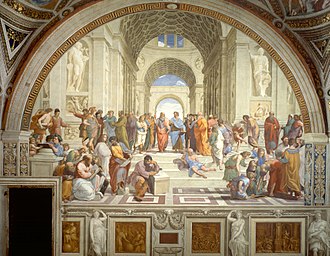
The truth and logic are mutually exclusive. Something can be logical, but not true. Something can be true, but not logical. For instance, give them an inch and they will take a mile is a slippery slope argument. Ask Neville Chamberlin about the consequences of choosing logic in that comparison.
Why do Christian institutions place Aristotle & his logic or science on a pedestal?
1 Corinthians 1:20 “Where is the wise? where is the scribe? where is the disputer of this world? hath not God made foolish the wisdom of this world? 21 For after that in the wisdom of God the world by wisdom knew not God, it pleased God by the foolishness of preaching to save them that believe. 22 For the Jews require a sign, and the Greeks seek after wisdom: 23 But we preach Christ crucified, unto the Jews a stumblingblock, and unto the Greeks foolishness; 24 But unto them which are called, both Jews and Greeks, Christ the power of God, and the wisdom of God.”
I do not need anyone to point out that by man’s standard my faith is illogical. I am not interested in logic, I am interested in the truth.
Colossians 2:2 “That their hearts might be comforted, being knit together in love, and unto all riches of the full assurance of understanding, to the acknowledgement of the mystery of God, and of the Father, and of Christ; 3 In whom are hid all the treasures of wisdom and knowledge.”
I have not located anything in the Bible that refers Christians to also seek Greek philosophers for some other wisdom or knowledge. The verse says “all.” In fact we receive a warning a few verses later:
Colossians 2:8 “Beware lest any man spoil you through philosophy and vain deceit, after the tradition of men, after the rudiments of the world, and not after Christ.”
Interpretations of the Bible are not found outside the word of God. The works of Plato & Aristotle are not a supplement to the Bible. Aristotle’s unmoved mover, his apathetic god is the complete opposite of Christianity:
John 3:16 “For God so loved the world, that he gave his only begotten Son, that whosoever believeth in him should not perish, but have everlasting life.”
Plato does not believe revelation, but instead apprehension–which is something more akin to the Prometheus story, which itself is akin to glorifying the devil. Also, avoid the silly claim that Plato or Aristotle influenced the Apostle Paul because the letters to the Corinthians & the Colossians were from him (and I believe what he wrote came from God).
I am not stating that studying Greek philosophy is evil, but what do they have to do with Christianity? Nothing. When it comes to God, the sum total of Greek philosophy is ignorance:
Acts 17:23 “For as I passed by, and beheld your devotions, I found an altar with this inscription, TO THE UNKNOWN GOD. Whom therefore ye ignorantly worship, him declare I unto you.”
Did the Apostle Paul apprehend his message? No.
Galatians 1:11 “But I certify you, brethren, that the gospel which was preached of me is not after man. 12 For I neither received it of man, neither was I taught it, but by the revelation of Jesus Christ.”
Some of the Greek philosophers are interesting, but let’s not synthesize their precepts with theology. The result is that people think they have found an alleged God Particle. Notice that some aspect of their scientific god is always beneath man somehow?
Isaiah 55:9 “For as the heavens are higher than the earth, so are my ways higher than your ways, and my thoughts than your thoughts.”
 THE EXILE OBSERVER