Christians & Greek philosophers

The truth and logic are mutually exclusive. Something can be logical, but not true. Something can be true, but not logical. For instance, give them an inch and they will take a mile is a slippery slope argument. Ask Neville Chamberlin about the consequences of choosing logic in that comparison.

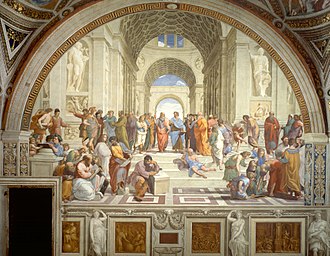
Why do Christian institutions place Aristotle & his logic or science on a pedestal?

1 Corinthians 1:20 “Where is the wise? where is the scribe? where is the disputer of this world? hath not God made foolish the wisdom of this world? 21 For after that in the wisdom of God the world by wisdom knew not God, it pleased God by the foolishness of preaching to save them that believe. 22 For the Jews require a sign, and the Greeks seek after wisdom: 23 But we preach Christ crucified, unto the Jews a stumblingblock, and unto the Greeks foolishness; 24 But unto them which are called, both Jews and Greeks, Christ the power of God, and the wisdom of God.”

I do not need anyone to point out that by man’s standard my faith is illogical.  I am not interested in logic, I am interested in the truth.

Colossians 2:2 “That their hearts might be comforted, being knit together in love, and unto all riches of the full assurance of understanding, to the acknowledgement of the mystery of God, and of the Father, and of Christ; 3 In whom are hid all the treasures of wisdom and knowledge.”

I have not located anything in the Bible that refers Christians to also seek Greek philosophers for some other wisdom or knowledge. The verse says “all.” In fact we receive a warning a few verses later:

Colossians 2:8 “Beware lest any man spoil you through philosophy and vain deceit, after the tradition of men, after the rudiments of the world, and not after Christ.”

Interpretations of the Bible are not found outside the word of God. The works of Plato & Aristotle are not a supplement to the Bible. Aristotle’s unmoved mover, his apathetic god is the complete opposite of Christianity:

John 3:16 “For God so loved the world, that he gave his only begotten Son, that whosoever believeth in him should not perish, but have everlasting life.”

Plato does not believe revelation, but instead apprehension–which is something more akin to the Prometheus story, which itself is akin to glorifying the devil. Also, avoid the silly claim that Plato or Aristotle influenced the Apostle Paul because the letters to the Corinthians & the Colossians were from him (and I believe what he wrote came from God).

I am not stating that studying Greek philosophy is evil, but what do they have to do with Christianity? Nothing. When it comes to God, the sum total of Greek philosophy is ignorance:

Acts 17:23 “For as I passed by, and beheld your devotions, I found an altar with this inscription, TO THE UNKNOWN GOD. Whom therefore ye ignorantly worship, him declare I unto you.”

Did the Apostle Paul apprehend his message? No.

Galatians 1:11 “But I certify you, brethren, that the gospel which was preached of me is not after man. 12 For I neither received it of man, neither was I taught it, but by the revelation of Jesus Christ.”

Some of the Greek philosophers are interesting, but let’s not synthesize their precepts with theology. The result is that people think they have found an alleged God Particle. Notice that some aspect of their scientific god is always beneath man somehow?

Isaiah 55:9 “For as the heavens are higher than the earth, so are my ways higher than your ways, and my thoughts than your thoughts.”


Attitudes on the End of the World


For Bible believers, we know that the governments & eventually a government of men will never build the kingdom of Heaven on Earth. It will be the exact opposite–there will be a one-world kingdom of darkness before the return of the Lord Jesus Christ:

Revelation 13:7 “And it was given unto him to make war with the saints, and to overcome them: and power was given him over all kindreds, and tongues, and nations. 8 And all that dwell upon the earth shall worship him, whose names are not written in the book of life of the Lamb slain from the foundation of the world.”

In the aforementioned verse “him” speaks of the beast from the sea. It is for this reason that many Christians adopt a laissez-faire attitude about things going on in their nation & world; it is going to happen anyway so why do anything about anything? The error with that attitude is that we do not know if it is the end of the world. There are signs that tell us it is near (Matt 24:33), but in the same chapter take note:

Matthew 24:8 “All these are the beginning of sorrows.”

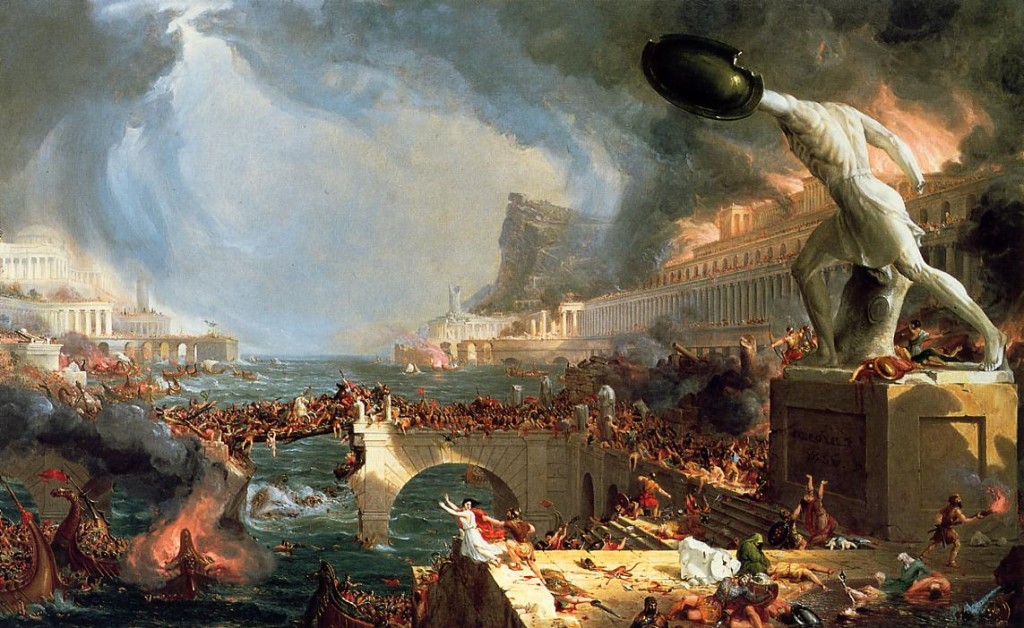
The sorrows are akin to a birth pangs. Generally the frequency & intensity of the pangs increase as the birth draws closer. Items from Matthew 24 can be applied to the rise & fall of many civilizations. The larger the civilization, the larger the fall. Many saints of yesteryear were convinced that the fall of Rome was the apocalypse. Consider the frequency & intensity when considering the scale of Rome. We do not know if this is the last civilization, but while the cycles follow Matthew 24, the Lord Jesus was speaking of the end of the world in Matthew 24:

Matthew 24:30 “And then shall appear the sign of the Son of man in heaven: and then shall all the tribes of the earth mourn, and they shall see the Son of man coming in the clouds of heaven with power and great glory. 31 And he shall send his angels with a great sound of a trumpet, and they shall gather together his elect from the four winds, from one end of heaven to the other.”

In Matthew 24 the claim that the Lord Jesus was speaking of the fall of Jerusalem & simultaneously speaking of the end of the world can be correct. Matthew 24 can be the model for the fall of civilizations and the final one-world civilization.

The main point of this article is that Christians should not let their country descend into a communist, atheistic state of darkness because they think it is the end of the world. It might not be and Christians may simply let their country transform into a miniature hell on Earth without a peep. Also, is that fair to our children?

I do believe that when the end does come, it will be undeniable for Bible-believing Christians. No prophecy in scripture will need to be worked or forced into a framework of a personal theory:

2 Thessalonians 2:1 “Now we beseech you, brethren, by the coming of our Lord Jesus Christ, and by our gathering together unto him, 2 That ye be not soon shaken in mind, or be troubled, neither by spirit, nor by word, nor by letter as from us, as that the day of Christ is at hand. 3 Let no man deceive you by any means: for that day shall not come, except there come a falling away first, and that man of sin be revealed, the son of perdition; 4 Who opposeth and exalteth himself above all that is called God, or that is worshipped; so that he as God sitteth in the temple of God, shewing himself that he is God.”

I can say that there has been a great falling away in the U.S. Even many professed Christians propagate a “Jesus” that is contrary to or not found in scripture. Their “Jesus” is molded solely by popular morality & politics. Many professed Christians seemingly do not believe the Bible at all. They take the attitude that men authored the Bible and that men at that time did not understand the science that we know today. Make no mistake, Aristotle’s science had already been around for centuries before the letter to Timothy:

1 Timothy 6:10 “O Timothy, keep that which is committed to thy trust, avoiding profane and vain babblings, and oppositions of science falsely so called:”

But again, the fall of the US is not necessarily the end of the world. I do not believe Christians should willfully let a free society where the Gospel of Jesus Christ can openly be preached descend into a society where we are persecuted for it. We are to preach it anyway, but why let those conditions develop if they can be avoided?


The Molten Calf


Exodus 32:1 “And when the people saw that Moses delayed to come down out of the mount, the people gathered themselves together unto Aaron, and said unto him, Up, make us gods, which shall go before us; for as for this Moses, the man that brought us up out of the land of Egypt, we wot not what is become of him.”

2 Peter 2:3 “Knowing this first, that there shall come in the last days scoffers, walking after their own lusts, 4 And saying, Where is the promise of his coming? for since the fathers fell asleep, all things continue as they were from the beginning of the creation.”

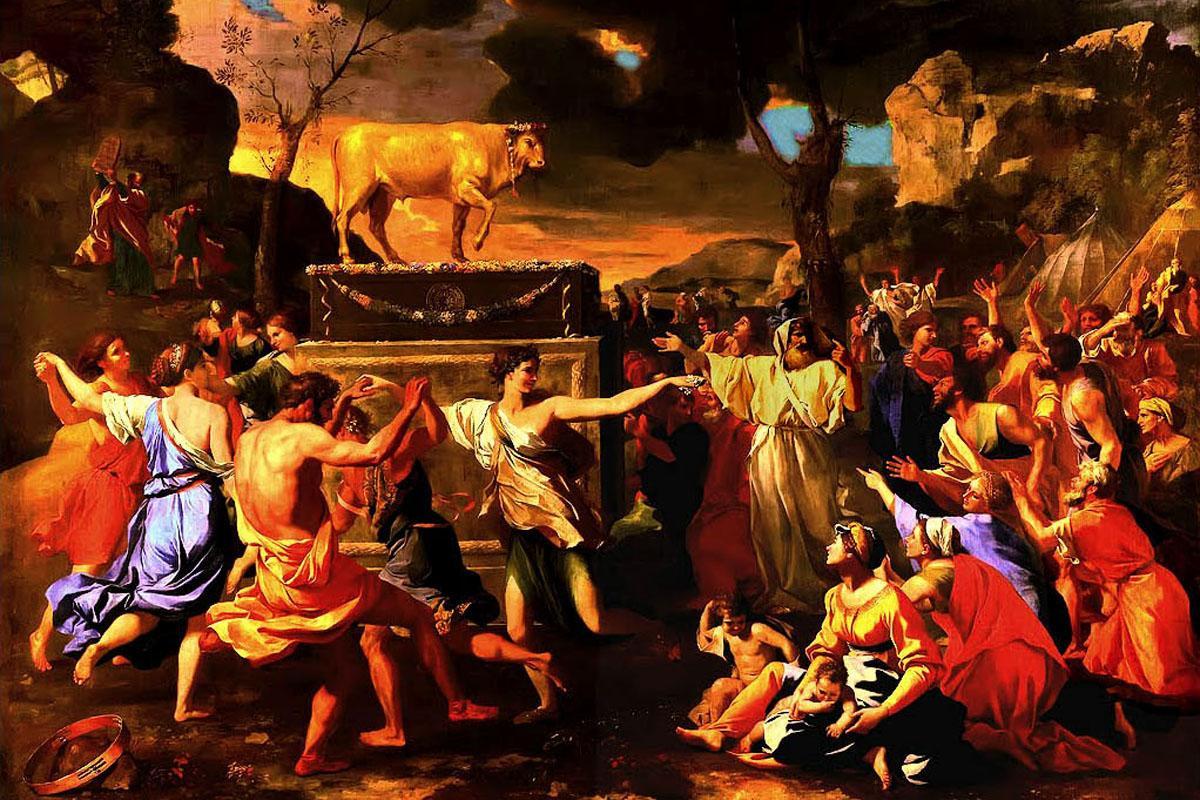
Many men have grown weary of waiting for the Lord Jesus Christ to return to Earth. Many lifetimes have passed during this wait. When Moses delayed in coming down from the mountain, the Israelites surmised that he may never return. They convinced the high priest Aaron to make them an idol–the molten calf.

I view modern political systems much like the molten calf. I pay attention to politics because there are groups who would label my King James Bible as hate speech & introduce legal consequences for even owning it. I will not let that happen without a peep. However, I understand that we men & our political systems will not build the kingdom of Heaven on Earth.

Many Christians have been drawn away by socialism (communism). Do they believe we will build the kingdom of Heaven and then the Lord Jesus will descend to rule? Is their goal a Karl Marx sort of heaven? What a lousy heaven, I have much higher expectations. The communists/socialists only use for the Bible is to find choice fragments that support their political system. They do not believe the Bible at all–it is only a tool to draw Christians to chase after their molten calf. Their “Jesus” is never given the titles of Lord or Christ. His mention is more akin to Lenin, Stalin or Mao.

There will not be a building, but rather a falling away first (2 Thess 2:3) before the Lord Jesus returns–just like before Moses came down from the mountain. Love thy neighbour is good, but that is half the story. What about the first and great commandment? The communist often reduce everything to love your neighbor, but their love is based off democratic moral relativism. Communists have completely altered what is preached in many Churches nowadays. Climate Change, healthcare, psychology or obsessively preaching about racism or sexism. We are bombarded by those issues by every secular institution & media. The ad nauseam doctrine of the world is not going to help a soul who has hit rock bottom. We need the word of God.

Many professed Christians I have met do not believe the Bible. They treat me like I am crazy for believing the events were real. They have a molten calf of their own, the theory of evolution (amongst other things) & love your neighbor. I am not sure if this is only western civilization’s falling away or the final falling away? I expect things to become much worse. That is not a prophecy, that is observing the trend. Either way the patience of the saints is mentioned in the book of Revelation (Rev 13:10, 14:12).

Moses came down from the mountain & the Lord Jesus Christ will return. Keep reading the Bible and do not lose the faith.


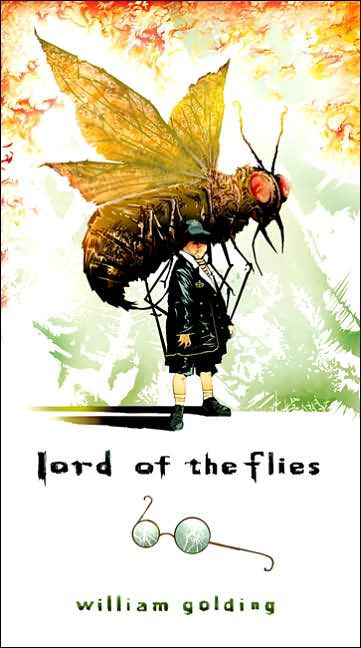
“The Lord of the Flies”–Symbols

Often in our increasingly godless society, entities attempt to hide Biblical allusions that can be found in classic literature. The 1980’s motion picture The Lord of the Flies was decent, but from my perspective it set out to force a civic-minded-only interpretation of the book. For instance, instead of a beast–it was always referred to as a monster. Also their monster arrived & developed under completely different circumstances–which destroyed the Biblical symbolism that I believe William Golding obviously intended.

All civic-minded interpretations aren’t wrong; Golding wrote himself that a theme in the book was that political systems didn’t matter as far as society; only the ethical nature of individuals.  The purpose of this blog is identify the Biblical allusions I perceived in Golding’s The Lord of the Flies:

Piggy’s glasses: The lenses represent the two tablets of the Ten Commandments. The glasses are the only means of lighting a fire on the island; thereby, the only source of light. One lens is broken early in the novel. This represents the absence of the first tablet or Commandments 1- 5. The first four commands deal with man’s relationship to God and the 5th is to honour your mother & father. There is no mention of God nor are their any adults (parents) on the island. When the boys establish their first (old) covenant on the mountain, their is no mention of God, the Bible or their parents when they make the laws. The boys are left with only one lens; Commandments 6-10, or how to love your neighbor. The battle for Piggy’s one lensed glasses represent the battle for control over morals on the island of neighbors.

Ralph & Piggy: Their relationship represents Aaron & Moses. Moses was worried about his stutter so God told him to have Aaron speak for him. When Piggy spoke he was always derided by the other boys; therefore, Ralph often delivered Piggy’s practical ideas to the assemblies instead. Piggy does not fully actualize the person of Moses, but some elements are present.

Jack: The main antagonist represents the beast from the sea. In the chapter named Beast from Water, an assembly is held at the shallow lagoon. Jack openly disrespects the law of the conch. The assembly is the first group mention a mythical beast on the island. Jack initially speaks against the beast tale, but as the novel continues more & more of his power relies on the beast myth. Later in the novel Jack attempts to democratically supplant Ralph as the leader of the group. When no one votes for Jack he is humiliated and cries. Figuratively, the beast from the sea was wounded. He leaves the group, but offers an open invitation for anyone to join his group. Initially only a few hunters follow him, but eventually his group includes everyone but Ralph, Piggy and a couple littluns. Jack can offer meat via the hunt, but not a continuous fire. He leads a raid to steal Piggy’s glasses. This represents that Jack now holds the power, via power, to direct the moral law on the island (one lens–Commandments 6-10). Eventually the law on the island degenerates into Jack’s power & his power and authority (his justifications) by the end of novel derive only from the beast from the air. For instance, the final hunt for Jack’s group is Ralph. Jack’s call to hunt Ralph contains zero moral justification & he has nothing to gain. He controls all the other boys on the island & has Piggy’s glasses. His only justification is that Ralph will be a sacrifice to the beast.

The Corpse of the Pilot: The corpse represents the dragon or the beast from the air. The book is set presumably during WWII. In the chapter Beast from Air, there is an aerial battle near the island. A pilot’s plane is shot down; he ejects & deploys his parachute, but dies from his wounds before he lands on the island. His corpse lands on the mountainside & his parachute is snagged on some rocks. Whenever the wind blows and catches the snagged parachute, the strings pull on the corpse and animate it in an odd manner–a twisted beast like leviathan. The boys only see the corpse & parachute in the dark or from afar. All the boys believe it is the beast–the earlier myth is confirmed in their minds. Of the whole event: there was war in heaven & Michael & his angels cast out the dragon & his angels. Thus, the fallen corpse represents the fallen dragon. In the Bible the dragon gives the beast from the sea his seat, power & authority.

Simon: Plays the role of a Christ-like figure. When Jack & the few hunters initially broke off from the main group, Simon witnessed their first hunt while he was concealed in the bush. Jack cuts off the head of the boar & places it on a pike. After Jack’s group sets up the first sacrifice for the beast, his group scurries off with the pigs body. Simon remains concealed & contemplates why the beast doesn’t claim his sacrifice. Flies swarm the boars head & Simon approaches it. The boar’s head is called the Lord of the flies by the narrator & Simon hallucinates that it speaks to him. The Lord of flies tells Simon that attempting to kill him (the beast) is folly & that there is a part of him in Simon & every man. The monologue indicates that Simon should not resist the beast within. This represents the temptation of Christ. Simon leaves the boar’s head & travels up the mountain (he injures his leg along the way). He encounters the beast from air & learns the truth: it is a corpse of a pilot. Simon staggers back to the group as fast as possible. He is the only one who knows the truth & if he can deliver this truth it will be like delivering a new covenant. Early in the novel all the boys established the first laws (old covenant) on the mountain, but now their behaviour & code was influenced more by the beast myth than anything else. Simon arrives on the beach during an inter-group pow wow. It is dark, a storm is raging, the boys are performing a pagan pig-stabbing dance & Simon crawls out of the forest. The boys mistake him as the beast & murder him. The storm winds had freed the parachute & corpse from the rocks. Immediately after the boys murdered Simon, the pilot corpse floated into their midst. They all fled in terror. In the movie the boys knew they murdered Simon, but in the novel they never knew they murdered Simon. After the boys flee, the pilot corpse & Simon are dragged out to sea.

The Conch: At first the conch is a symbol of the first moral law on the island. You could only speak during an assembly if you hold the conch. Later the conch is an idol or the molten calf. After Jack’s group steals Piggy’s glasses, Piggy still has faith in the power of the conch. He proposed that he & what is left of Ralph’s group will march over to Jack’s group & demand the return of his glasses. Piggy believes that Jack must hear him because of the power of the conch. With the conch in hand Piggy will tell Jack, “What’s right’s right.” When Ralph’s group does march over, there is scuffle, but Piggy temporary quells the struggle by yelling that he holds the conch & must be heard. He raises the conch aloft & begins his discourse. During his discourse, some hunters on a higher cliff roll a boulder off the edge. It not only strikes and kills Piggy, but also smashes the conch into a thousand pieces. This sequence represents Moses smashing the tablets of the Ten Commandments & grinding the molten calf into powder. Moses himself is not represented in the boys struggle. Piggy is the first deliberate murder on the island–there is no longer any law on the island written in stone. The conch is the grounded idol. The conch, the molten calf in this tale is faith in a system created by men.

The Soldier on the Beach: The absence of adults on the island represents the absence of God from a civilization. The soldier on the beach represents the unexpected return of God. Jack’s group engages in their final hunt–they hunt Ralph. After evading the hunters Ralph stumbles on the beach & encounters an adult soldier. The hunters emerge from the forest behind. When all the boys see the adult soldier on the beach, they begin to realize their state of total depravity. A civic irony Golding provided himself is that while the adult saved the boys from their war–he was also in the midst of a war. The adults were in a war over their own molten calf (political systems).

Ralph: His early status is covered; he is loyal to the old covenant, but by the end of the book he is transformed & represents the end time saints who refuse to worship the beast. He never loses faith that adults (God) will return.

Orwell’s “1984”–The Divine Tragedy

Dante Alighieri’s Comedy and George Orwell’s 1984. The Comedy on it’s veneer is the tale of a backslider’s return to God and 1984 is the tale of backslider’s return to the State (the Party).

In 1984, Virgin Films & Umbrella-Rosenblum Films produced a movie version of Nineteen Eighty-Four. It was close enough to the book to appreciate; save for the omission of my favourite line from the book:

“We control matter, because we control the mind” (1984, book 3, chapter 3).

Aside from that, the short clip below from the movie will suffice to demonstrate my main point. The clip begins after the protagonist Winston has been successfully rehabilitated via torture:

(I edited the clip to begin at 5:25. End the video when the credits roll)

https://youtu.be/BjDg3lQGmRs?t=5m25s


Save for one detail, the clip from the movie mirrors the end of the book. The end of 1984 is a twisted version of the end of Dante’s Paradiso. I could give a line-by-line comparison of the end of both books, but it is much easier to paraphrase:

Dante stares at the three-fold circles of the Trinity.                                                          Winston stares at the news on television screen.

Dante sees an effigy of a man (Jesus Christ) appear in the 2nd circle of the Trinity.      Winston sees a man (Big Brother or BB) appear on the television screen.

Dante is given understanding to answer the mystery of how man fits in with God. Winston finally understands the mystery of the smile under BB’s mustache (book only).

Dante is filled with love for God.                                                                                                        Winston is filled with love for Big Brother.

I used Paradiso as the first example, but 1984 is an inversion of the entire Comedy.

Winston’s inferno begins with Julia (Beatrice)–he has a “fire in his belly.” Shortly thereafter, that’s when the antagonist O’brien introduces himself. BTW–O’brien is the bizarro-world Virgil.

Virgil accompanies Dante from the beginning of Inferno to the top of Mount Purgatorio. The top of Mount Purgatorio is the terrestrial paradise–that would be called “Room 101” in 1984. O’brien guides Winston through his inferno to Room 101. Notice how Winston envisions beautiful rolling hills in association with Room 101? In the Comedy, Virgil stops and delivers many discourses; so to with O’brien and his discourses in the 1984.

Virgil’s greatest discourse comes in Canto XVII of Purgatorio–his discourse on love. Here is a famous portion of the discourse from the Longellow translation of the Comedy:

“Hence thou mayst comprehend that love must be
The seed within yourselves of every virtue,
And every act that merits punishment” (Purgatorio, 17.102-105)

O’brien delivers a parody of Virgil’s discourse on love:

“We shall abolish the orgasm. Our neurologists are at work upon it now. There will be no loyalty, except loyalty towards the Party. There will be no love, except the love of Big Brother” (1984, Book 3, Chapter 3).

O’brien’s discourses come while he is torturing Winston. He parody’s discourses on love, freewill & the soul found in the Comedy.

In the Comedy, the Roman poet Statius joins Dante & Virgil in the 5th Circle of Purgatorio and accompanies them to the top of the mountain. Orwell is a great writer and didn’t leave out Statius; he named him Parsons. Lo and behold, we meet Parsons early in the book, he also ends up in the holding cell with Winston and he completes the journey to the terrestrial paradise or Room 101.

In Purgatory  the shades are purged of their vice; they must perform the opposite–if gluttony, then fasting. At the Ministry of Love thought criminals are purged of their thought crimes; they must confess the opposite.

In 1984, Goldstein is Satan or Dis. Although Winston ends up illegally making love to Julia several times, he hasn’t reached the lowest circle of Inferno yet–treachery. That happens when he reads Goldstein’s book; that’s treachery against the Party.

There are many, many more details, but the blog has shown you enough. You can have fun finding more parallels on your own. In conclusion, Orwell’s 1984 is a genius work of parody, which is why I call it The Divine Tragedy.


Dante Alighieri


I wrote my college thesis on the works of Dante Alighieri (c. 1265-1321). If I were to create renaissance currency, I would place Dante on the $100 bill. Proto and later Renaissance figures looked up to him. Even Rodan’s sculpture, The Thinker was originally The Poet in the Gates of Hell.

Not only should Dante be considered the leading proto-Renaissance figure, but also a proto-Reformer. Thus, don’t be scared off by Dante if you are a Protestant like me. Dante may not generally be placed at the forefront of both the Renaissance & The Reformation because the Black Plague struck Italy a few decades after he died. This left a gulf between Dante and later well-known figures.

Here are some interesting things that are not well known about his works:

Dante did not label his Comedy, divine (the label was applied nearly two centuries after his death). Dante resided in the court of a noble named Cangrande when he wrote Inferno & Purgatorio. He resided in the court of Guido Novella when he wrote Paradiso. However, Dante sent Cangrande a copy of Paradiso and a letter, which provided his own title for the complete work:

“The title of the book is ‘Here beginneth the Comedy of Dante Alighieri, a Florentine by Birth, but not in character’” (1).

Dante certainly wasn’t ignorant of the Bible. In his works he quoted the Bible far more than any other source. One must understand his work is not doctrine, it is a poem. Dante mentions the “third heaven” from 2 Corinthians 12:2 in Chapter XIV of The Convivo. His heavens were set in three major divisions, the stars (planets), the Milky Way and God.

Also, understand Dante’s use of poetic allegory. Dante said in Chapter XIV of The Convivo: “I say that by heaven I mean science, and by the heavens the sciences…” From there he compared each of his poetic heavens later used in Comedy to the classical liberal arts:

Circle of Paradiso Convivo
The Moon Grammar
Mercury Dialectic
Venus Rhetoric
The Sun Arithmetic
Mars Music
Jupiter Geometry
Saturn Astronomy
The Fixed Stars Physics/Metaphysics
Primum Mobile Moral Science
Empyrean Divine Science

What follows were some of the conclusions from my thesis:

Dante’s Comedy is his poetic autobiography. I performed a comparative analysis of his much earlier autobiographical work Vita Nuova to his Comedy. I concluded that Vita Nuova was an embryonic version of Inferno & Purgatorio.

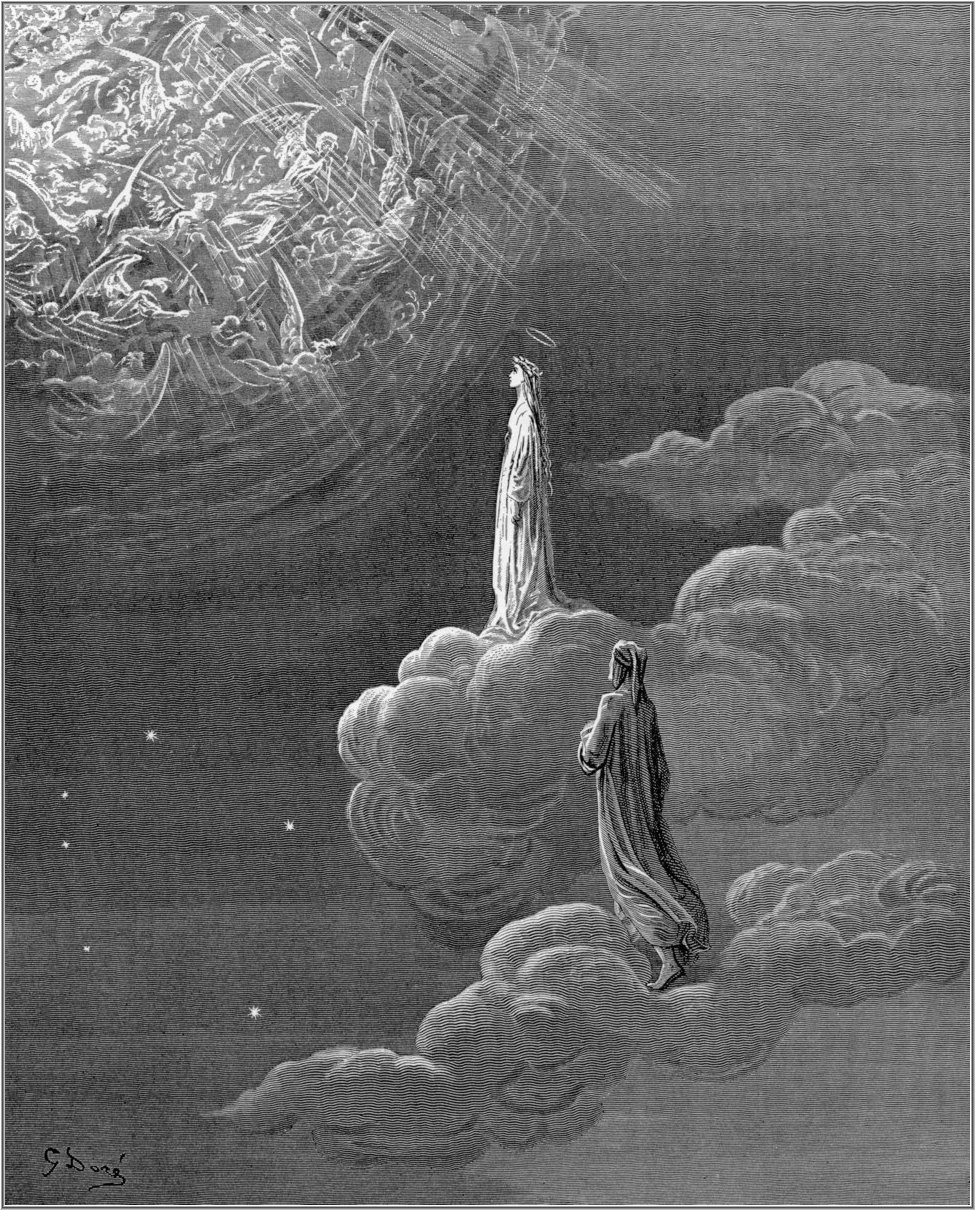
Dante’s heavens or the classical liberal arts (the Trivium, Quadrivium & Theology) were the subjects that brought him happiness after his exile. In Paradiso, Dante is guided by Beatrice. Her appearance becomes more brilliant & glorious with each new circle of Paradise. That represents the light & joy Dante received from studying each subject–the greatest resulting from Divine Science or Theology. His Comedy ends with his future death or ultimate return to God.

Thus, the stages and characters of the Comedy are just as much based off the crime, punishment & reward of some as it is encounters & circumstances from Dante’s real life timeline. There is a mix of characters for those two reasons. Beatrice was Dante’s  Inferno. The walls of the city of Dis separated his condition before & immediately after Beatrice’s death. You could say it separated his obsession & depression. For instance, Dante contemplated suicide after her death (the 7th Circle–violence).

 I learned in Vita Nuova that Dante was intrigued with the number 9. He associated that number with Beatrice in several entries. Guess what–the inferno has 9 circles. So now you know why Dante (I say again–who knew the Bible well) placed 10 heavens & 9 hells in his poem.

Before I conclude, here is some bonus material from my comparative analysis of Vita Nuova & the Comedy: Dante’s poetic treachery. I believe Virgil represents Dante’s poetry in the Comedy. Who sent Virgil to guide Dante–Beatrice. Who inspired Dante’s first poetry–Beatrice. In Vita Nuova all Dante’s poetry was inspired by Beatrice (muse) until…

Something before I continue that is related; in Inferno all the rivers mentioned fall & converge in its lowest circle Cocytus (treachery). The bodies of water become frozen. This represents Dante’s frozen tears over Beatrice.

I believe Cocytus is reflected late in Vita Nuova when Dante returns to a familiar spot in Florence to sulk over Beatrice’s passing. He notices a fair, young woman staring at him from behind a window. Because of the pity in her eyes she temporarily becomes Dante’s new muse. Treachery! There can be only one muse! Vita Nouva concludes with Dante’s vision of the heavenly Beatrice. Dante rejects the anti-muse & finally escapes his real life hell.

Beatrice represented the things that brought Dante joy. At first it was Beatrice in the flesh; later it was Beatrice or Lady Philosophy. He called his anti-muse pity. It was joy vs pity and like Cocytus, Dante could have been frozen in a state of desiring pity forever.

A clue to Dante’s treachery is found in the Comedy when he finally reunites with Beatrice atop Mount Purgatorio. Beatrice chastises him–to include:

“As soon as ever of my second age [her death]
I was upon the threshold and changed life,
Himself from me he took and gave to others.” (Purgatorio 30.124-126)

I have much more to say about Dante & his works, but I hope you enjoyed this small offering.


(1) Pg 196, Toynbee, Paget , Dante Alighieri: His Life and Works, Dover Publications Inc.