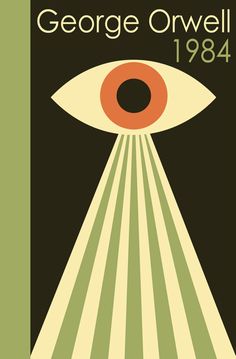
Dante Alighieri’s Comedy and George Orwell’s 1984. The Comedy on it’s veneer is the tale of a backslider’s return to God and 1984 is the tale of backslider’s return to the State (the Party).
In 1984, Virgin Films & Umbrella-Rosenblum Films produced a movie version of Nineteen Eighty-Four. It was close enough to the book to appreciate; save for the omission of my favourite line from the book:
“We control matter, because we control the mind” (1984, book 3, chapter 3).
Aside from that, the short clip below from the movie will suffice to demonstrate my main point. The clip begins after the protagonist Winston has been successfully rehabilitated via torture:
(I edited the clip to begin at 5:25. End the video when the credits roll)
Save for one detail, the clip from the movie mirrors the end of the book. The end of 1984 is a twisted version of the end of Dante’s Paradiso. I could give a line-by-line comparison of the end of both books, but it is much easier to paraphrase:
Dante stares at the three-fold circles of the Trinity. Winston stares at the news on television screen.
Dante sees an effigy of a man (Jesus Christ) appear in the 2nd circle of the Trinity. Winston sees a man (Big Brother or BB) appear on the television screen.
Dante is given understanding to answer the mystery of how man fits in with God. Winston finally understands the mystery of the smile under BB’s mustache (book only).
Dante is filled with love for God. Winston is filled with love for Big Brother.
I used Paradiso as the first example, but 1984 is an inversion of the entire Comedy.
Winston’s inferno begins with Julia (Beatrice)–he has a “fire in his belly.” Shortly thereafter, that’s when the antagonist O’brien introduces himself. BTW–O’brien is the bizarro-world Virgil.
Virgil accompanies Dante from the beginning of Inferno to the top of Mount Purgatorio. The top of Mount Purgatorio is the terrestrial paradise–that would be called “Room 101” in 1984. O’brien guides Winston through his inferno to Room 101. Notice how Winston envisions beautiful rolling hills in association with Room 101? In the Comedy, Virgil stops and delivers many discourses; so to with O’brien and his discourses in the 1984.
Virgil’s greatest discourse comes in Canto XVII of Purgatorio–his discourse on love. Here is a famous portion of the discourse from the Longellow translation of the Comedy:
“Hence thou mayst comprehend that love must be
The seed within yourselves of every virtue,
And every act that merits punishment” (Purgatorio, 17.102-105)
O’brien delivers a parody of Virgil’s discourse on love:
“We shall abolish the orgasm. Our neurologists are at work upon it now. There will be no loyalty, except loyalty towards the Party. There will be no love, except the love of Big Brother” (1984, Book 3, Chapter 3).
O’brien’s discourses come while he is torturing Winston. He parody’s discourses on love, freewill & the soul found in the Comedy.
In the Comedy, the Roman poet Statius joins Dante & Virgil in the 5th Circle of Purgatorio and accompanies them to the top of the mountain. Orwell is a great writer and didn’t leave out Statius; he named him Parsons. Lo and behold, we meet Parsons early in the book, he also ends up in the holding cell with Winston and he completes the journey to the terrestrial paradise or Room 101.
In Purgatory the shades are purged of their vice; they must perform the opposite–if gluttony, then fasting. At the Ministry of Love thought criminals are purged of their thought crimes; they must confess the opposite.
In 1984, Goldstein is Satan or Dis. Although Winston ends up illegally making love to Julia several times, he hasn’t reached the lowest circle of Inferno yet–treachery. That happens when he reads Goldstein’s book; that’s treachery against the Party.
There are many, many more details, but the blog has shown you enough. You can have fun finding more parallels on your own. In conclusion, Orwell’s 1984 is a genius work of parody, which is why I call it The Divine Tragedy.
 THE EXILE OBSERVER